Evidence Before the Milestone: Building HTA, RWE and Economic Strategy for Advanced Therapies
Why advanced therapies need early, integrated planning for evidence synthesis, external controls, RWE, economic modelling, HTA and reimbursement?
A pivotal-trial milestone, regulatory designation or label expansion can move a therapy closer to patients, but it does not automatically establish comparative value, affordability or reimbursement readiness. Regulators, health technology assessment bodies and payers examine related yet distinct questions. They may require evidence on treatment effect, relevant comparators, long-term outcomes, resource use, uncertainty and the consequences of adoption.
This matters particularly for advanced therapies, rare diseases, paediatric indications and treatments supported by small or single-arm studies. In these settings, evidence generation cannot be postponed until the clinical programme is complete. Natural-history research, external-comparator planning, real-world evidence and economic modelling need to develop alongside the clinical strategy.
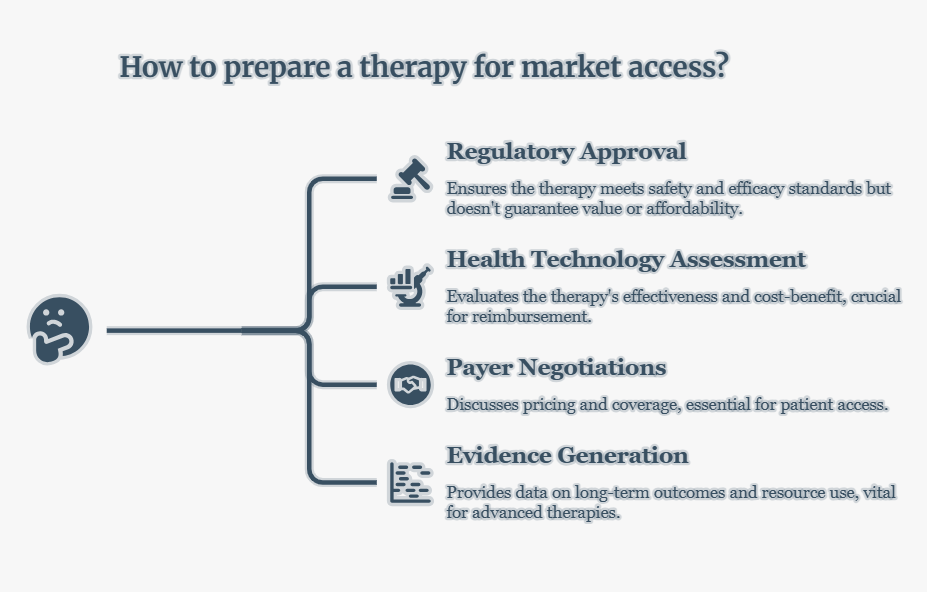
Regulatory milestones now trigger broader evidence requirements
FDA’s Rare Disease Evidence Principles recognise that therapies for very small genetically defined populations may require a broader evidentiary package. Depending on the programme, confirmatory evidence may include mechanistic, non-clinical, pharmacodynamic and other clinical data, as well as appropriately selected external controls or natural-history evidence [1]. (U.S. Food and Drug Administration)
At the same time, the European Union’s joint clinical assessment process has applied to new oncology medicines and advanced therapy medicinal products since 12 January 2025 [6]. Joint assessment does not remove country-level reimbursement requirements, but it increases the importance of preparing comparator, outcome and subgroup evidence early enough to address questions across multiple health systems. (Public Health)
The practical implication is clear: regulatory, scientific-publication and market-access workstreams should be coordinated rather than developed sequentially.
Create one evidence backbone for several decisions
An integrated evidence strategy starts with a structured understanding of the disease, current care pathway and decision problem. A systematic literature review can identify epidemiology, natural history, treatment patterns, clinical outcomes, utilities, resource use and costs. The same evidence map can then inform endpoint selection, external-control feasibility, indirect comparisons, economic modelling and publication planning.
The review should not be treated as a static report. Search updates, transparent screening, structured extraction and traceable evidence tables make it possible to reuse the evidence without repeatedly rebuilding the foundation. Where appropriate, meta-analysis or network meta-analysis can quantify comparative effects, while GRADE or CERQual approaches can communicate certainty and limitations.
This shared evidence backbone also reduces inconsistencies between clinical summaries, manuscripts, payer materials and economic-model inputs.
External controls are study designs, not shortcuts
External comparators can be valuable when randomisation is difficult, unethical or operationally unrealistic. However, historical records or registry data do not become a credible control group simply because they are available.
FDA guidance highlights the need to address comparability between treated and external populations, including eligibility criteria, index dates, outcome definitions, follow-up, data collection and potential sources of bias [3]. Natural-history studies should likewise be protocol-driven and designed around the clinical-development question they are intended to answer [2]. (U.S. Food and Drug Administration)
A defensible assessment should therefore examine data provenance, missingness, confounding, treatment-era effects and sensitivity to alternative analytical choices. When major differences cannot be resolved, the external data may still help interpret endpoints or model disease progression, but stronger causal claims should be avoided.
Design real-world evidence around a defined purpose
Registries, electronic health records, claims databases and early-access programmes can provide information on patient characteristics, treatment pathways, safety, effectiveness and healthcare utilisation. FDA describes RWE as clinical evidence derived from analysis of routinely collected real-world data and uses it across the medical-product lifecycle [4]. (U.S. Food and Drug Administration)
Data availability alone is insufficient. FDA guidance asks whether the source is relevant and reliable for the proposed regulatory question, while the European Medicines Agency’s data-quality framework emphasises provenance, completeness and fitness for use [4,5]. (U.S. Food and Drug Administration)
Evidence teams should define the target population, exposure, comparators, outcomes, estimand and analytical plan before selecting a database. This reverses the common but risky practice of choosing an accessible dataset first and deciding later what question it might answer.
Build the economic model before reimbursement deadlines
Health-economic modelling is often initiated after pivotal results become available. By that stage, important inputs such as health-related quality of life, treatment-resource requirements, caregiver effects or downstream events may not have been collected adequately.
Early model conceptualisation can reveal these gaps while evidence-generation plans remain adaptable. The model should specify the decision problem, perspective, comparators, health states, time horizon and sources of uncertainty. Where costs or benefits extend beyond observed follow-up, extrapolation assumptions should be explicit and tested through scenario and sensitivity analyses.
NICE’s methods recognise real-world and observational sources within technology evaluation and use economic analysis to assess costs and health benefits [7,8]. Good-practice recommendations also emphasise transparent model structure, validation and clear communication of uncertainty [9]. (Nice)
For advanced therapies, this may require cost-utility analysis, budget-impact modelling, Markov models or patient-level microsimulation capable of representing heterogeneous pathways and long-term consequences.
Treat publication and submission planning as one system
Clinical reports, congress materials, manuscripts, regulatory summaries and HTA dossiers should draw from controlled, traceable evidence sources. Shared protocols, analysis plans, evidence tables, model documentation and version control improve consistency while allowing each output to answer its own audience’s question.
A practical programme can progress through linked stages: target evidence profiling, systematic evidence synthesis, external-control or NMA feasibility, RWE protocol development, early economic modelling, and coordinated publication and submission support. Each stage should document assumptions, limitations and decisions so that analyses remain reproducible when new data arrive.
Epi Fractals supports this integrated approach through systematic reviews, meta-analysis, network meta-analysis, HEOR, RWE, economic modelling, medical writing and market-access evidence development [10]. (Epifractals) Its capabilities can be applied across cost-effectiveness and budget-impact analyses, Markov models, microsimulation, patient-journey mapping, R-Shiny tools, regulatory documentation and publication planning.
For teams approaching a pivotal, regulatory or reimbursement milestone, an early discussion about evidence synthesis, RWE, HTA or modelling requirements can help establish a transparent and decision-focused evidence roadmap.
References
[1] U.S. Food and Drug Administration. 2025. CDER/CBER Rare Disease Evidence Principles (RDEP). FDA.
[2] U.S. Food and Drug Administration. 2020. Rare Diseases: Natural History Studies for Drug Development. Draft Guidance for Industry. FDA.
[3] U.S. Food and Drug Administration. 2023. Considerations for the Design and Conduct of Externally Controlled Trials for Drug and Biological Products. Draft Guidance for Industry. FDA.
[4] U.S. Food and Drug Administration. 2026. Real-World Evidence. FDA.
[5] European Medicines Agency. 2026. Data Quality Framework for EU Medicines Regulation: Application to Real-World Data. EMA.
[6] European Commission. 2026. Joint Clinical Assessments. Directorate-General for Health and Food Safety.
[7] National Institute for Health and Care Excellence. 2022. NICE Real-World Evidence Framework. NICE.
[8] National Institute for Health and Care Excellence. 2022. NICE Technology Appraisal and Highly Specialised Technologies Guidance: The Manual. NICE.
[9] Eddy DM, Hollingworth W, Caro JJ, et al. 2012. Model Transparency and Validation: A Report of the ISPOR-SMDM Modeling Good Research Practices Task Force-7. Value in Health, 15(6), 843–850.
[10] Epi Fractals. 2026. FAQs: RWE, HEOR, HTA and Evidence Synthesis. Epi Fractals.