From Regulatory Milestone to Market Access: Building an Evidence Continuum That Decision-Makers Can Use
Regulatory milestones are only the start. Learn how connected SLR, NMA, HEOR, RWE and economic modelling can strengthen market-access evidence.
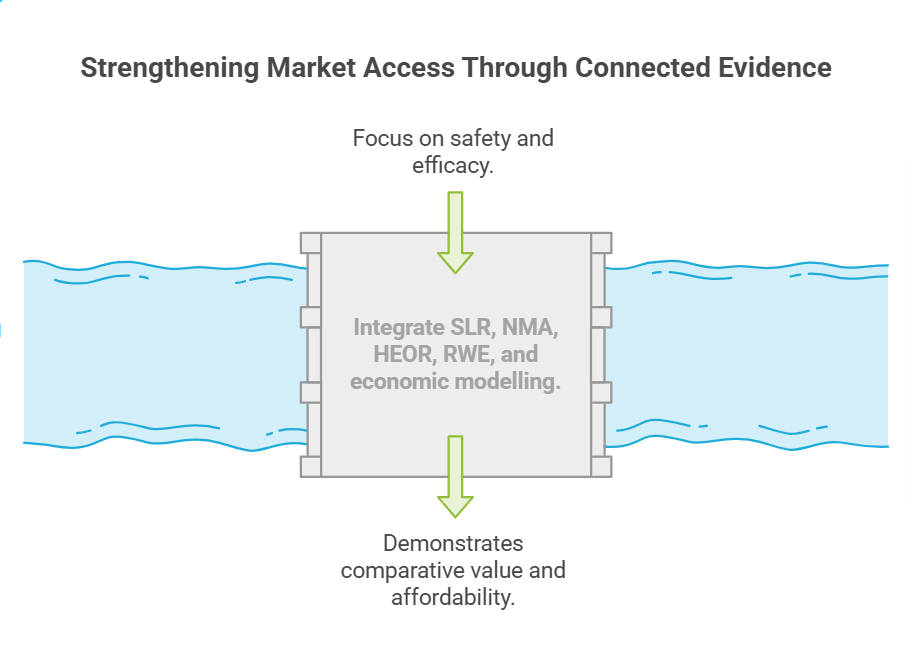
A regulatory milestone can transform the evidence question almost overnight. Before approval or clearance, the focus is often safety, efficacy and technical performance. Immediately afterwards, payers, HTA bodies, hospitals and policy-makers may ask different questions: How does the technology compare with current practice? Which patients benefit most? What resources will implementation require? Is the expected improvement worth the additional cost?
These questions matter because clinical progress does not automatically establish comparative value, affordability or reimbursement readiness. Current regulatory and HTA frameworks increasingly reinforce the need for evidence that can travel across the product lifecycle, from evidence synthesis and comparative effectiveness to economic modelling and real-world evidence (RWE). [1–6]
Regulatory progress creates a new evidence problem
Regulatory authorization and market-access decisions serve related but distinct purposes.
For example, the US FDA’s Accelerated Approval Program allows earlier approval of qualifying drugs based on surrogate or intermediate clinical endpoints considered reasonably likely to predict clinical benefit. Sponsors must still conduct studies to confirm the anticipated benefit. [1]
Medical technologies face a similarly evolving evidence environment. FDA’s December 2025 guidance clarifies how real-world data should be evaluated for sufficient quality when RWE is intended to support regulatory decision-making for medical devices. [2]
Reimbursement frameworks can introduce additional requirements. Under Medicare’s New Technology Add-On Payment pathway, for example, CMS considers criteria including newness, cost and substantial clinical improvement. For diagnostic technologies, the assessment of substantial clinical improvement can include whether earlier or otherwise unavailable diagnosis changes patient management. [3]
The strategic implication is straightforward: evidence planning should not stop at the regulatory endpoint.
Comparative evidence should be prepared before the access question arrives
HTA frequently requires a technology to be understood relative to relevant alternatives rather than in isolation.
NICE states that a comprehensive and transparent evidence base is fundamental to technology evaluation. When relevant technologies have not been compared within a single randomized controlled trial, its methods explicitly provide for indirect comparisons and network meta-analysis (NMA), while requiring the associated uncertainty to be characterized. [4]
This makes early systematic literature review (SLR) valuable beyond publication preparation. A well-designed review can identify comparator evidence, treatment pathways, outcome definitions, evidence gaps and potential effect modifiers before an HTA submission or economic model is under time pressure.
For crowded treatment landscapes, an SLR can progress into meta-analysis or NMA. GRADE can support transparent assessment of certainty in quantitative evidence, while CERQual may be appropriate when qualitative findings, such as barriers, implementation factors or patient experiences, influence the decision problem.
Economic modelling translates evidence into a decision context
Comparative clinical evidence answers only part of the value question. Decision-makers must also understand what adoption could mean for health outcomes, resource use and expenditure.
NICE’s methods require consideration of costs and resource use alongside relative clinical effectiveness, while its HealthTech programme allows economic approaches including cost-utility and cost-comparison analyses where appropriate. [5,6]
The model structure should follow the decision problem rather than the other way around. A relatively stable chronic pathway may be represented through a cohort Markov model. Patient-level heterogeneity, recurrent events or complex histories may justify microsimulation. Budget-impact analysis can address affordability and uptake over a payer-relevant time horizon, while cost-effectiveness or cost-utility analysis considers the relationship between incremental outcomes and costs.
Sensitivity and scenario analyses are equally important because early value estimates commonly depend on uncertain treatment effects, uptake assumptions, resource utilization and longer-term extrapolation.
RWE needs a protocol, not simply a dataset
Real-world evidence is also becoming more relevant across the medical-product lifecycle. FDA describes RWE as potentially contributing to regulatory decisions involving effectiveness and safety and identifies sources including electronic health records, claims, registries and digital-health data. [7]
But access to data does not by itself create useful evidence. The research question, target population, comparators, outcomes, data provenance, missingness, confounding strategy and analytical plan should be specified before analysis wherever possible.
That distinction becomes particularly important after launch. RWE can examine treatment patterns, patient characteristics, resource use, implementation and outcomes under routine conditions, while also providing empirical inputs that can update assumptions used in earlier economic models.
Diagnostics and medical technologies need an evidence chain
For diagnostics, AI-enabled technologies and medical devices, technical performance may represent only the beginning of the value story.
The relevant evidence chain can extend from diagnostic accuracy to changes in clinical decision-making, downstream outcomes, workflow consequences, resource utilization and costs. NICE’s unified HealthTech programme explicitly covers diagnostics, devices and digital technologies, while recognising both clinical and economic evaluation. [6]
This creates a strong rationale for connecting diagnostic-accuracy reviews, patient-journey mapping, clinical-utility analysis and economic modelling rather than producing them as unrelated deliverables.
Build one evidence architecture instead of separate projects
The most useful evidence programmes connect methods.
An SLR can define the comparator landscape. Meta-analysis or NMA can estimate relative treatment effects. Epidemiological research and patient-journey mapping can establish population and pathway parameters. Cost-effectiveness, budget-impact or microsimulation models can translate these inputs into decision outcomes. RWE can subsequently test or refresh important assumptions. Medical writing and regulatory or HTA documentation can ensure that the underlying methods, limitations and uncertainty remain transparent.
Epi Fractals supports this connected approach across evidence synthesis, NMA, GRADE and CERQual assessments, HEOR and economic modelling, RWE, HTA documentation and decision-support work. [8] The objective is not to manufacture certainty, but to make the available evidence rigorous, transparent, reproducible and useful for the decision being made.
If your clinical, regulatory or commercial programme is approaching an evidence inflection point, Epi Fractals welcomes discussions on HEOR, RWE, HTA, evidence synthesis and economic-modelling requirements.
References
[1] U.S. Food and Drug Administration. 2026. Accelerated Approval Program. FDA. FDA Accelerated Approval Program
[2] U.S. Food and Drug Administration. 2025. Use of Real-World Evidence to Support Regulatory Decision-Making for Medical Devices. FDA Guidance. FDA medical-device RWE guidance
[3] Centers for Medicare & Medicaid Services. 2026. New Medical Services and New Technologies. CMS. CMS NTAP guidance
[4] NICE’s early value assessment: an external assessment group’s commentary on the challenges and opportunities of NICE’s new life cycle approach to HealthTech. 2025. Int J Technol Assess Health Care.
[5] How to Secure NICE Approval in the NHS: Scientific and Health-Economic Guide for Health Tech. 2026. Odelle Technology Ltd.
[6] NICE updates health technology evaluation manuals. 2026. Med-tech Insights.
[7] U.S. Food and Drug Administration. 2026. Real-World Evidence. FDA. FDA Real-World Evidence resource
[8] Epi Fractals. 2026. Our Services. Epi Fractals. Epi Fractals services