Regulatory Milestones Are Not Market-Access Milestones: Building the Evidence Bridge Before Launch
Regulatory milestones compress evidence timelines. Learn how SLR, NMA, RWE and economic modelling can support HTA, reimbursement and market access.
A major regulatory milestone can change an evidence programme overnight. Fast Track designation, acceptance of an NDA or BLA, European marketing authorisation, or a new reimbursement pathway may compress timelines and sharpen stakeholder attention. But none of these events, by itself, answers the questions that payers, HTA bodies, clinicians, health systems and regulators may ask next: How does the technology compare with relevant alternatives? How certain is the evidence? What happens in routine practice? What is the effect on healthcare budgets, pathways and patient outcomes?
That distinction matters for market access. Organisations that wait until approval to connect clinical evidence, comparative effectiveness, real-world evidence and economic modelling may find that the evidence needed for the next decision has not been generated in the form, population or timeframe required.
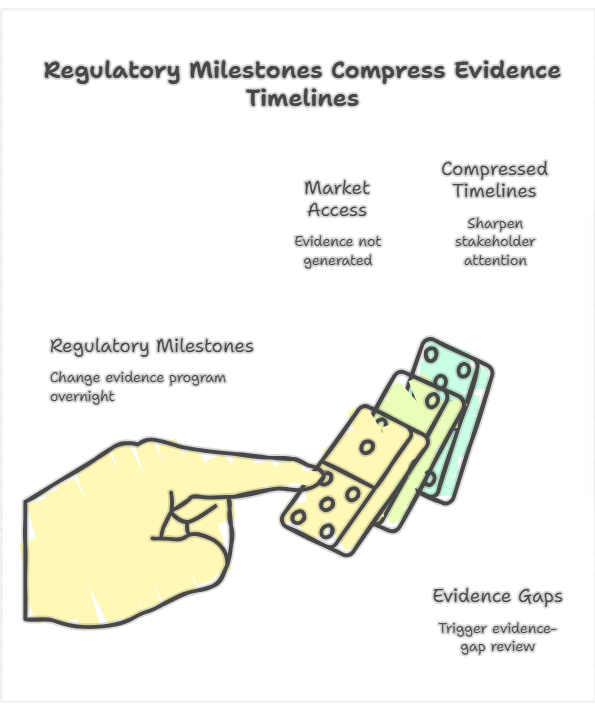
Regulatory acceleration creates evidence compression
FDA Fast Track is intended to facilitate development and expedite review for therapies addressing serious conditions and unmet medical needs. Among its features is the possibility of rolling review of completed sections of an NDA or BLA.[1]
Faster interaction, however, does not eliminate evidence uncertainty. In rare diseases, this issue can be especially visible because patient populations are small and natural-history information may be incomplete. FDA has specifically described natural-history studies as potentially useful across rare-disease drug development, including clinical-study planning.[2]
The implication is practical: a regulatory milestone should trigger an evidence-gap review, not simply a regulatory-writing workstream.
For a late-stage programme, that review may examine whether the clinical package adequately characterises disease progression, current treatment, clinically relevant outcomes, comparators and important sources of uncertainty. Where external controls or historical benchmarks are being considered, assumptions around population comparability, endpoint definitions, data provenance and bias need to be explicit.
Comparative evidence should be built before the payer asks for it
A positive pivotal trial establishes an important part of the clinical case, but reimbursement decisions frequently require a broader comparison with existing care.
NICE states that when relevant technologies have not been evaluated within one randomised trial, evidence from pairwise trials should, where appropriate, be accompanied by network meta-analysis. Its methods also emphasise systematic identification of evidence, transparent inclusion decisions and assessment of uncertainty, heterogeneity and inconsistency.[3]
This makes the systematic literature review more than a publication exercise. A well-designed SLR can create the evidence backbone for:
-
comparator identification and treatment-landscape assessment;
-
pairwise or network meta-analysis;
-
natural-history and epidemiological parameterisation;
-
health-economic modelling;
-
payer and HTA documentation;
-
future evidence updates as new studies appear.
The objective is not to conduct every analysis automatically. It is to design the review so that evidence can be reused transparently across downstream decisions.
Europe makes the need for coordinated planning clearer
The EU Health Technology Assessment Regulation has applied since 12 January 2025. Joint clinical assessments initially cover new oncology medicines and advanced therapy medicinal products, with phased expansion planned over subsequent years.[4]
Importantly, the European Commission specifies that joint clinical assessments focus on clinical domains. They do not make reimbursement conclusions or conduct the national economic appraisal; Member States can add information such as cost-effectiveness when making national decisions.[5]
This separation creates a strong argument for parallel evidence planning. Relative clinical effectiveness, comparator strategy and subgroup questions should be aligned with the economic evidence that may later be needed nationally. Waiting for one assessment to finish before beginning the next can make adaptation more difficult when comparators, populations or practice patterns differ between jurisdictions.
Economic models therefore need to be treated as living decision frameworks rather than static spreadsheets. Cost-effectiveness, cost-utility and budget-impact analyses should make assumptions traceable, quantify uncertainty and allow scenarios to be updated as prices, treatment pathways, epidemiology and evidence evolve. NICE explicitly integrates evidence synthesis with economic evaluation and requires uncertainty around key relationships to be characterised.[6]
Approval is also the beginning of the real-world evidence question
Regulatory evidence describes whether a technology can be authorised for a defined use. Real-world evidence can help answer a different set of questions about what happens after implementation.
FDA's RWE programme recognises the potential for fit-for-purpose real-world data to support regulatory decisions across the product lifecycle. Its guidance addresses data sources, study design, variables, bias, confounding, analysis and reporting for non-interventional studies.[7]
For medicines, this may mean studying utilisation, treatment persistence, safety or outcomes in populations under-represented in trials. For diagnostics and AI-enabled technologies, the evidence question may extend further into referral patterns, workflow changes, downstream testing, resource use and clinical utility.
NICE's evidence standards framework for digital health technologies illustrates this broader perspective. It includes real-world demonstration of claimed benefits, budget-impact analysis and, for technologies with greater financial risk, economic evaluation.[8]
In the US inpatient setting, CMS likewise maintains a separate New Technology Add-on Payment process for qualifying technologies, reinforcing that regulatory and payment pathways answer different questions.[9]
Build one evidence architecture, not multiple disconnected deliverables
The strategic opportunity is to connect evidence activities early. An SLR can define the comparator landscape. An NMA can estimate relative treatment effects when head-to-head evidence is incomplete. Those estimates can inform cost-effectiveness and budget-impact models. Natural-history and epidemiological work can support both regulatory contextualisation and model structure. RWE can subsequently test assumptions against routine practice.
Epi Fractals supports this type of connected evidence work across systematic reviews, meta-analysis and NMA, HTA documentation, economic and budget-impact analysis, real-world data analysis and scientific medical writing.[10]
The value lies in keeping methods transparent, assumptions reproducible and outputs adaptable as the decision context changes.
A regulatory milestone should therefore be treated as an evidence-planning signal. For teams approaching submission, approval, reimbursement or launch, this is the point to ask what the next decision-maker will need and whether today's evidence can answer tomorrow's question.
To discuss an upcoming HEOR, RWE, HTA, evidence-synthesis or economic-modelling requirement, Epi Fractals welcomes conversations about building a rigorous and practical evidence pathway around the decisions ahead.
References
[1] U.S. Food and Drug Administration. 2014/current. Fast Track; Expedited Programs for Serious Conditions: Drugs and Biologics. FDA. FDA Fast Track information
[2] U.S. Food and Drug Administration. 2019. Rare Diseases: Natural History Studies for Drug Development. Draft Guidance for Industry. FDA. FDA rare-disease natural-history guidance
[3] National Institute for Health and Care Excellence. 2025. Technology Appraisal and Highly Specialised Technologies Guidance: The Manual, Evidence. NICE. NICE evidence-synthesis methods
[4] European Commission. 2026. Joint Clinical Assessments; Implementation of Regulation (EU) 2021/2282. Directorate-General for Health and Food Safety. European Commission JCA information
[5] European Commission. 2025. Implementing the EU Health Technology Assessment Regulation: Joint Clinical Assessment for Medicinal Products. European Commission. EU HTA JCA factsheet
[6] National Institute for Health and Care Excellence. 2025. Technology Appraisal and Highly Specialised Technologies Guidance: The Manual, Economic Evaluation. NICE. NICE economic-evaluation methods
[7] U.S. Food and Drug Administration. 2023–2026. Real-World Evidence Guidance and ICH M14 General Principles for Non-interventional Studies Using Real-World Data. FDA. FDA Real-World Evidence programme
[8] National Institute for Health and Care Excellence. 2022. Evidence Standards Framework for Digital Health Technologies. NICE. NICE digital-health evidence standards
[9] Centers for Medicare & Medicaid Services. 2026. New Medical Services and New Technologies. CMS. CMS New Technology Add-on Payment information
[10] Epi Fractals. 2026. Our Services. Epi Fractals. Epi Fractals services