The Evidence Clock Starts Before the Pivotal Readout
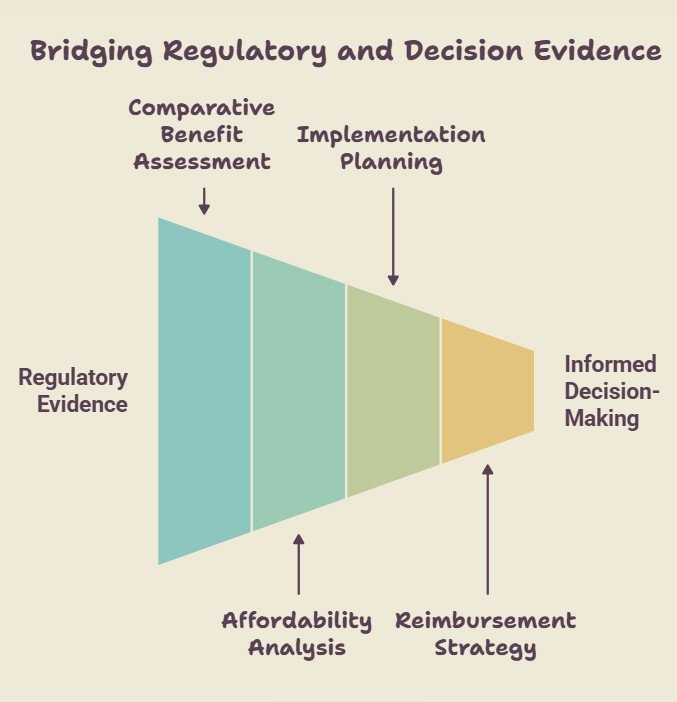
Recent life-sciences signals reveal a consistent pattern across oncology, immunology, rare disease, medical devices and digital health. Positive pivotal results, registrational-trial launches, evolving regulatory pathways and new clearances are rapidly followed by questions about comparative benefit, affordability, implementation and reimbursement.
This matters because regulatory evidence and decision evidence are not identical. A trial may establish efficacy against its protocol-defined control, yet payers and health technology assessment bodies must judge the intervention against locally relevant alternatives, patient pathways and resource constraints. Evidence synthesis, health economics and real-world evidence therefore need to begin before the publication, submission or launch deadline becomes fixed.
A Clinical Milestone Changes the Question
A pivotal readout answers an important clinical question, but it rarely resolves the complete market-access decision problem. Decision-makers may still need to understand how an intervention compares with treatments absent from the pivotal trial, where it belongs in a treatment sequence, which patients are most likely to benefit and whether the expected health gains justify the additional cost.
This requirement is becoming more structured. The EU Health Technology Assessment Regulation has applied since 12 January 2025, initially covering new cancer medicines and advanced therapy medicinal products through joint clinical assessments. Developers must respond to an assessment scope built around population, intervention, comparator and outcome questions, while Member States may conduct additional national appraisal, including cost-effectiveness analysis [1]. (Public Health)
The practical implication is clear: evidence teams cannot wait until regulatory filing to determine whether the available trials form a credible comparative network.
Build the Comparative Evidence Architecture Early
An early systematic literature review should do more than collect publications. It should map the decision landscape: relevant populations, standards of care, emerging competitors, outcomes, follow-up periods, treatment-effect modifiers and evidence gaps.
A network meta-analysis feasibility assessment can then determine whether the evidence forms a connected and clinically coherent network. It should examine differences in baseline risk, previous treatment, biomarker definitions, outcome measurement and trial timing before statistical synthesis is attempted. NICE recognises network meta-analysis and adjusted indirect comparisons as methods for estimating relative effectiveness when direct comparisons are unavailable, but it also expects additional uncertainty to be acknowledged when comparisons do not preserve randomisation or rely on weaker evidence [2]. (Nice)
This work should connect directly to economic modelling. Relative treatment effects, adverse events, treatment duration, subsequent therapy and survival extrapolation often become inputs to cost-utility or cost-effectiveness models. NICE describes modelling as a framework for synthesising evidence into estimates of clinical and cost effectiveness and expects decision uncertainty to be quantified [3]. (Nice)
The systematic review, comparative analysis and economic model should therefore be treated as one evidence system, not three disconnected deliverables.
Different Technologies Require Different Evidence Bridges
Crowded treatment pathways
In therapeutic areas containing multiple biologics, targeted therapies, cell therapies or combination regimens, the central challenge is often treatment sequencing. A single pairwise comparison cannot show how every option performs across earlier and later lines of care.
A living SLR, NMA and treatment-sequence model can help evaluate this changing landscape. Scenario analyses should test alternative sequences, comparator definitions, treatment waning assumptions and subsequent-therapy distributions. These analyses do not remove uncertainty, but they make its sources visible and decision-relevant.
Rare diseases and external controls
Randomised evidence may be limited in rare diseases, gene therapies or accelerated-development programmes. Natural-history cohorts and external controls may then contribute to the evidence package.
FDA’s draft guidance on externally controlled trials emphasises careful control selection and alignment between treated and external populations [4]. Credible analyses require prespecified eligibility criteria, a consistent time zero, comparable outcome definitions, transparent handling of missing data and sensitivity analyses addressing measured and unmeasured differences. External-control evidence should not be presented as equivalent to randomisation. Its value depends on the fitness of the data and the credibility of the design. (U.S. Food and Drug Administration)
Medical devices and digital health
Regulatory clearance does not automatically establish provider adoption or reimbursement value. Hospitals and health systems may still require evidence on workflow, clinician time, training, resource utilisation, complications, patient adherence and total cost of care.
FDA’s December 2025 medical-device guidance explains that real-world data must be sufficiently relevant and reliable to generate evidence suitable for regulatory decision-making [5]. Prospective implementation studies, pragmatic analyses and budget-impact models can extend this evidence toward payer and provider decisions [6]. (U.S. Food and Drug Administration)
AI Can Accelerate Evidence, but Accountability Remains Human
AI-assisted searching, screening, extraction and reporting can increase efficiency, particularly when evidence volumes are large. It does not remove responsibility for methodological decisions.
In July 2026, the EU Member State Coordination Group on HTA issued principles for AI use in joint clinical assessment dossiers. The principles require human oversight, accountability and transparent identification of AI-assisted steps. They also expect reporting of the tool, version, developer, date and purpose, with prompts recorded and available if requested [7].
A defensible AI-assisted workflow therefore needs validated procedures, dual review where judgement is material, version-controlled extraction records, reproducible code and a documented audit trail. Speed is valuable only when the evidence remains inspectable.
From Milestone to Decision-Ready Evidence
The strongest evidence programmes begin with the anticipated decision, not the available dataset. Early joint scientific consultation can help developers understand evidence expectations while clinical studies and investigations are still being planned [8]. (Public Health)
Epi Fractals supports this process through systematic reviews, meta-analysis, network meta-analysis, GRADE, CERQual, cost-effectiveness and budget-impact analysis, Markov models, microsimulation, RWE, patient-journey research, R-Shiny tools, regulatory documentation and publication support. Its public positioning emphasises rigorous, transparent and reproducible evidence development across life sciences, HealthTech and market access.
The pivotal result may attract attention, but evidence readiness determines whether that result can be translated into a credible clinical, economic and reimbursement case. Epi Fractals welcomes discussions about upcoming HEOR, RWE, HTA, evidence-synthesis and modelling requirements.
References
[1] European Commission. 2026. Joint Clinical Assessments. Public Health, European Commission.
[2] National Institute for Health and Care Excellence. 2022. Evidence: NICE Technology Appraisal and Highly Specialised Technologies Guidance Manual. NICE.
[3] National Institute for Health and Care Excellence. 2022. Economic Evaluation: NICE Technology Appraisal and Highly Specialised Technologies Guidance Manual. NICE.
[4] US Food and Drug Administration. 2023. Considerations for the Design and Conduct of Externally Controlled Trials for Drug and Biological Products. Draft Guidance.
[5] US Food and Drug Administration. 2025. Use of Real-World Evidence to Support Regulatory Decision-Making for Medical Devices. Final Guidance.
[6] US Food and Drug Administration. 2026. Real-World Evidence. FDA.
[7] Member State Coordination Group on Health Technology Assessment. 2026. General Principles on the Use of Artificial Intelligence in the Preparation of Dossiers for Joint Clinical Assessments. European Commission.
[8] European Commission. 2026. Joint Scientific Consultations. Public Health, European Commission.